Would you trust a pilot who’s never seen a cockpit?
Let me start with a simple question:
Would you board a fully automated plane if no one on board knew how to fly?
Not as a backup.
Not in an emergency.
Not even to notice when something feels wrong.
That is the moment we are living in with AI.
The systems are powerful. The automation is impressive. But safety still depends on whether a
human can recognize when the machine is drifting off course. Education is not about
resisting technology. It is about ensuring someone is awake in the cockpit.
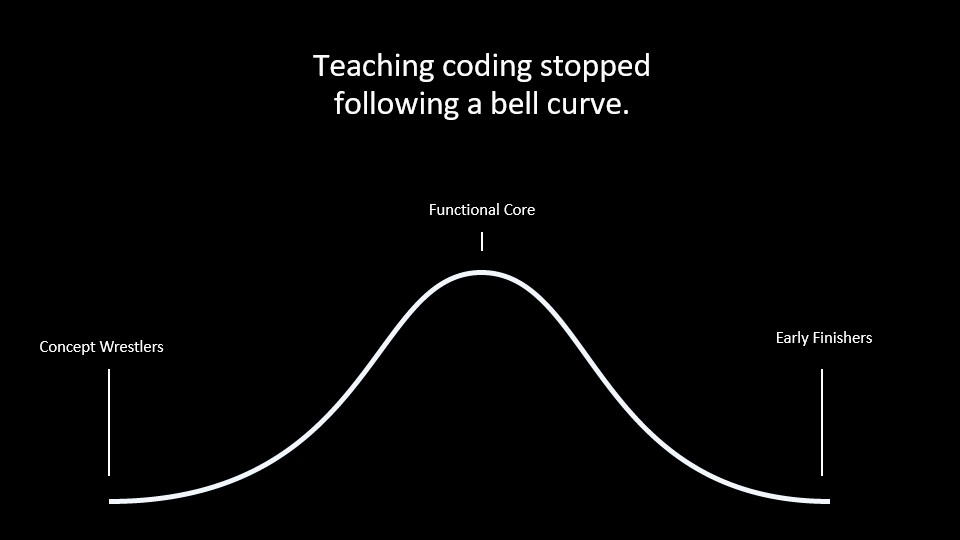
Teaching coding stopped following a bell curve.
I’ve been teaching coding for over 30 years. For the first 20 years, learning followed a familiar pattern. Most students struggled at first, then gradually improved. A few were fast, a few were slow, but nearly everyone could eventually use the core ideas. Then something changed.
About 10 years ago, I found that the coding concepts "if statements" and "arrays" became
unteachable to half the class. Not harder to teach, but polarized. Some students grasped
the concepts in minutes and used them creatively. Others could work on examples for weeks
and still could not apply them independently. There was no bell curve anymore. Just two groups.
I blamed screen time. I was wrong!
It is more complex than just screen time. Students with strong foundational skills learned quickly regardless of screen time. Students without those foundations, stalled, no matter how much instruction they received. What I was seeing was not just distraction. It was missing cognitive scaffolding.
Now with large language models, this split is widening. Students with foundations can use AI
to think faster and deeper. Students without foundational skills use AI to complete
assignments without any understanding. The gap is no longer between fast and slow learners.
It is between "learners" and "assignment finishers". And that gap is growing.
When effort disappears, learning atrophies.
If we stop practicing basic operations—calculation, estimation, logic, persistence—we don’t
just forget techniques. We lose internal reference points.
Those reference points are what tell us, “Something is wrong here.”
Convenience feels like progress, but it has a cost. This is not about working harder for
its own sake. It is about staying in control when the machine is confident and wrong.
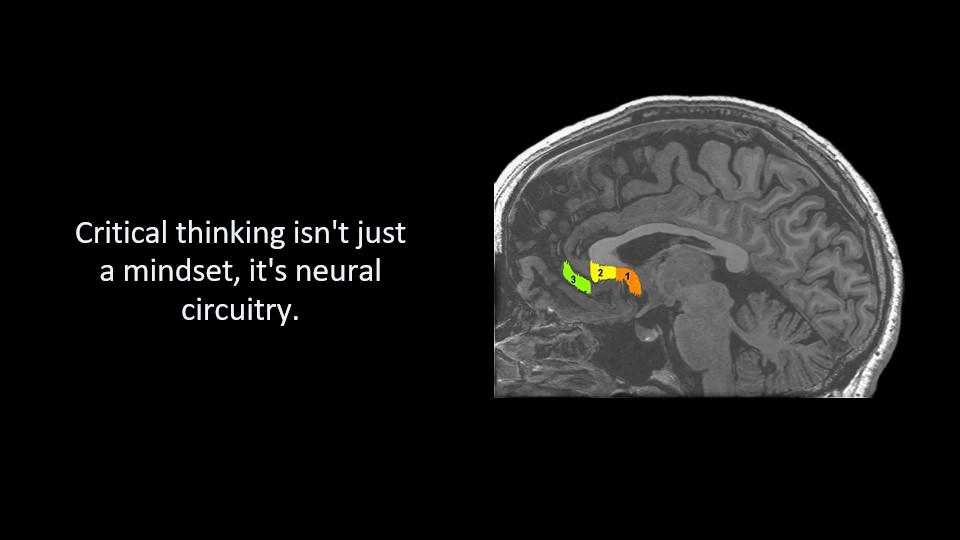
Critical thinking is not a mindset. It is neural circuitry.
This is not a metaphor. It is neuroscience. The Added Problem:
Banning phones can help students focus, but it doesn’t teach them how to manage distraction.
Students need internal motivation and self-control whether a phone is present or not.
The real task is helping them use phones to support learning, rather than letting phones
shape how they think.
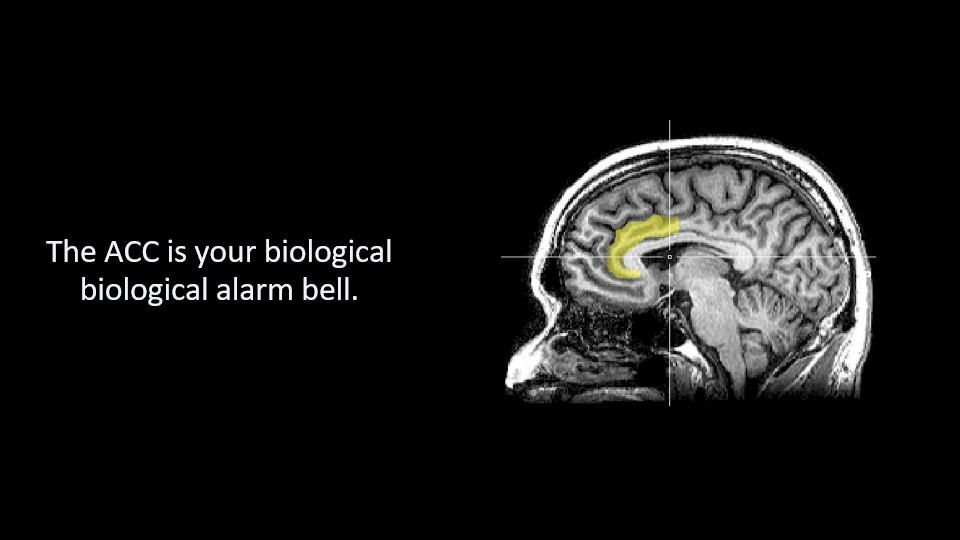
The ACC: your biological alarm bell.
The anterior cingulate cortex (ACC) activates when an answer conflicts with expectations.
It does not shout. It whispers. It produces doubt, the feeling that something doesn’t quite fit.
That signal only develops if we regularly do the work ourselves. No effort, no alarm.
Carter et al., 1998
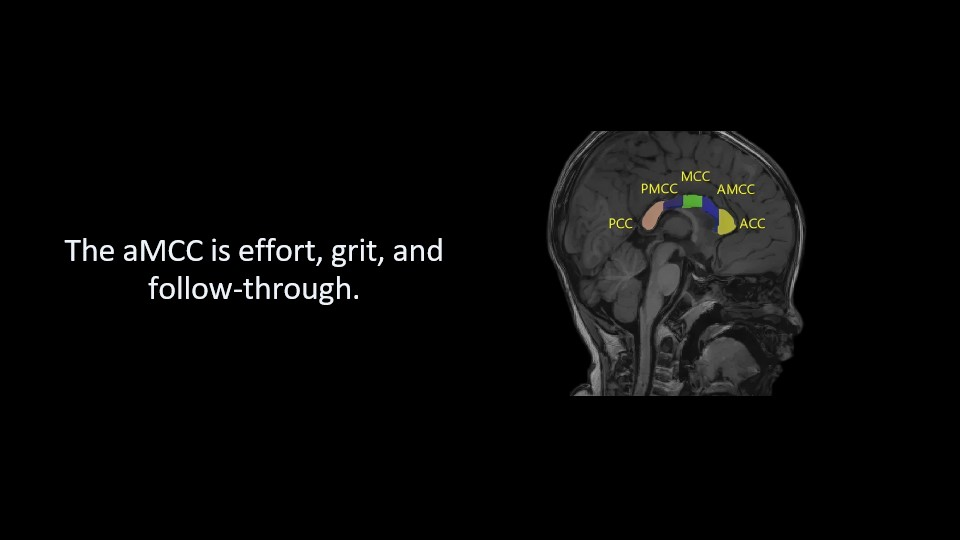
The aMCC: effort, grit, and follow-through.
The anterior mid-cingulate cortex (aMCC) is associated with sustained effort, will power
and persistence. It strengthens when we do difficult things we would rather avoid.
It weakens when we consistently choose the easiest path. When students rely on frictionless
answers instead of effortful thinking, these systems are not engaged.
Convenience doesn’t just change behavior. It changes the brain.
Touroutoglou et al., 2020
AI generates probabilities, not facts.
AI systems do not check truth. They generate likely sequences of words.
In 2023, a lawyer submitted a legal brief generated by AI. It cited six court cases.
Every one of them was fabricated. Convincing. Detailed. Entirely fictional.
A first-year law student would have caught it. The lawyer did not. Why? No baseline.
No internal alarm. No correction.
Mata v. Avianca, Inc., 2023
We didn’t just lose arithmetic. We lost number sense.
In the 1980s, calculators freed us for high-level math. That part worked, but we paid a price:
we lost the "gut feeling" for estimation and magnitude, the internal alarm that says,
“That answer can’t be right.”
The Flynn Effect shows this same divergence at scale. While teenagers gained "game-like"
visual problem-solving, our foundational reasoning skills have stalled or reversed.
We are trading deep cognitive intuition for surface-level speed. AI is accelerating
this trade-off. It doesn't just affect math; it targets language, logic, and judgment,
the very systems our internal "pilot" needs to stay alert.
Flynn Effect Bratsberg & Rogeberg, 2018
AI amplifies foundations; it does not create them.
Some students thrive with AI. They build faster and explore deeper.
They share one trait: strong foundations. AI does not create ability. It amplifies it.
The danger is not replacement. The danger is divergence, a widening gap driven by missing
fundamentals.
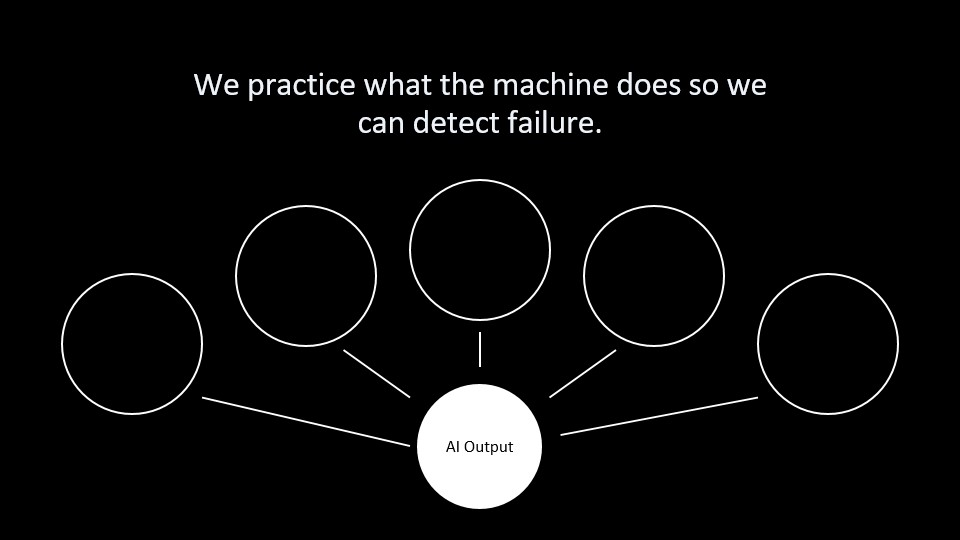
We practice what the machine does so we can detect failure.
Reasoning and persistence allow students to detect contradictions.
Context and empathy reveal when a correct response is humanly wrong.
Language precision exposes fluency without depth.
Ethical judgment asks not just "Is this correct?" but “Is this responsible?”
We practice what the machine does so we know when it fails.
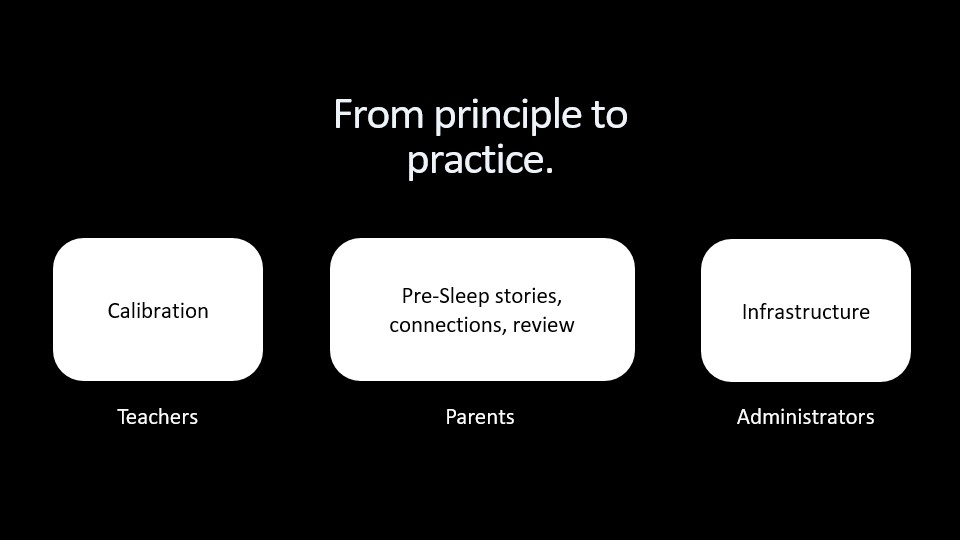
From principle to practice.
This is not a philosophical problem.
It is a practical one.
Here are three actions we could do now.
This is not abstract. These actions work.
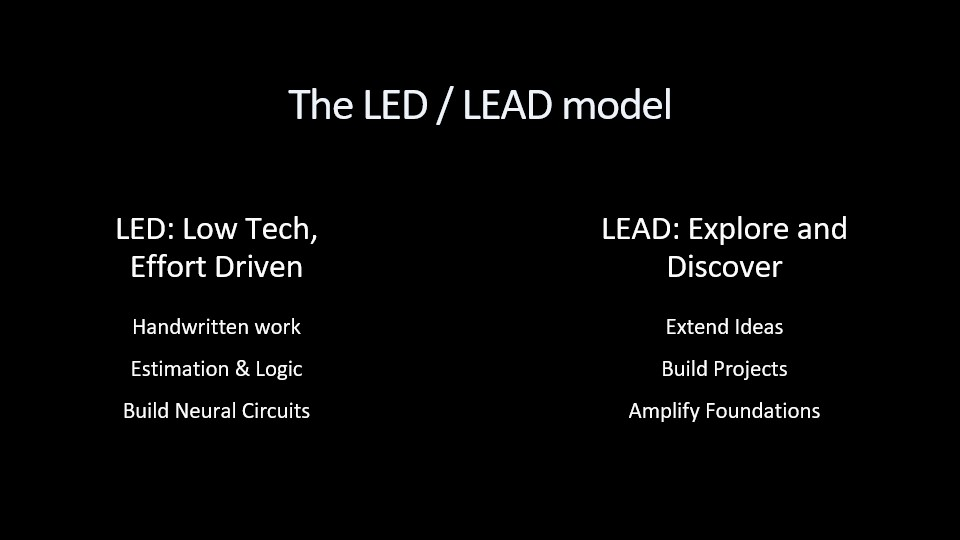
The LED / LEAD model.
Teachers are welcome to try for short amounts of time:
LED, Low-tech, Effort-Driven
Handwriting, math, estimation, retrieval practice.
Goal: engage ACC and aMCC while foundations form.
LEAD, High Level, Personal Persistence, Explore, And Discover
Curricular Extend, test, and build.
Goal: amplify solid understanding, curricular personal choice.
The ratio tells you everything:
Too few reach LEAD → LED was too hard.
Everyone reaches LEAD instantly → LED was too easy. Effort is non-negotiable.
Curiosity is rewarded.
What happens before sleep determines what sticks.
Parents can do a home version of LED / LEAD but more importantly, before sleep, the brain enters
hypnagogia, a critical window where it reviews daily sustained effort to consolidate learning.
Too often, this window is lost to scrolling.
For elementary children: bedtime stories. For middle school students: conversation,
what was confusing, what was fun, make a connection. For High School Students:
Review the days lessons before sleep, this strengthens memory and intuition.
Walker, M. P., & Stickgold, R. (2006)
Auditing AI is a system-wide responsibility.
When students struggle in Grade 10, we blame the Grade 10 Math and English teachers!
But the gap was built over years.
My suggestion is to implement a school-wide grade 10 skills audit, early and late in the year.
Not subject-based. Skills-based. Estimation. Reading under pressure. Reasoning.
Sustained problem-solving.
Every teacher owns a piece of the human pilot:
Elementary: The Foundation. Hard-wiring the basics.
If you can’t do the mental math or read the sentence fluently, you have no "spare" brain power
to question the AI.
Middle School: The "Gut" Feeling.
Developing the internal alarm that goes off when an answer just looks wrong.
It’s teaching kids to trust their instincts over the screen.
Math: Reality Checks. Using quick estimation to catch the machine’s mistakes.
It’s about being "close enough" in your head to know the AI is way off.
English: Reading the Room. Finding the hidden meaning.
AI can generate text, but it can’t understand intent, tone, or the "vibe" of a human conversation.
Science: Real-World Testing. If the AI’s logic doesn’t work in a physical experiment,
the AI is wrong. Science is the bridge between the screen and the dirt.
Social Studies: Checking the Source. Asking "Who told you this and what do they want?"
It’s about spotting bias before it becomes "truth."
Electives: Hands-on Mastery. Skills that require a body, such as cooking, building,
playing an instrument. You can't "prompt" your way to physical excellence.
No blame. Shared ownership. If we want students who can audit AI, we must measure and
train that ability honestly.
Not faster answers, better judgment.
The future does not need people who can outpace machines.
It needs people who can recognize when machines are wrong.
If students can calculate, they can question.
If they can reason, they can verify.
If they can persist, they can stay engaged when the system is confident and incorrect.
Education’s role is not to slow technology down, and never has been.
It is to ensure humans are strong enough to stand beside AI.
Someone must always be thinking in the cockpit.
That is the job.